Amir Muhammad Khan Calls for Accountability of Federal Minister Chaudhry Salik Hussain, Questions Overseas Pakistanis Ministry’s Performance and Demands Annual Performance Reports
(By Amir Muhammad Khan)
Pakistan’s political landscape has once again witnessed a debate over government spending and accountability after Federal Minister for Overseas Pakistanis and Human Resource Development Chaudhry Salik Hussain raised questions about the Punjab government’s funds and their utilization. Punjab’s Chief Minister has responded by signaling the possibility of legal action.
However, an important question arises: when a government official demands accountability from another province or institution, should the performance of his own ministry not also come under public scrutiny?
Questioning the use of public money is a legitimate democratic responsibility. But transparency, financial discipline and accountability must apply equally to federal ministries and provincial governments. Public funds, whether allocated by Punjab or the federal government, must be spent according to necessity, public interest and measurable results.
Chaudhry Salik Hussain Must Explain His Ministry’s Performance
Having observed the challenges faced by Pakistanis in Saudi Arabia for the past 43 years, I have witnessed the difficulties experienced by overseas Pakistanis and the officials responsible for providing them with assistance.
Pakistani diplomatic missions, particularly embassies and consulates, frequently struggle to provide timely services because of inadequate staffing and insufficient facilities.
This raises important questions for the federal minister. How many times has Chaudhry Salik Hussain visited Saudi Arabia, which hosts a substantial Pakistani community? Has he personally examined the difficulties faced by overseas Pakistanis and the officials appointed to serve them?
More than 1.2 million Pakistanis reside in Saudi Arabia’s Western Province, which falls under the jurisdiction of the Pakistani Consulate in Jeddah. Are sufficient staff, resources and facilities available to meet their needs?
Government departments often expect diplomatic officials to deliver exceptional results despite shortages of personnel and basic facilities. The Community Welfare Department under the Ministry of Overseas Pakistanis faces similar challenges.
It is also questionable whether senior officials in Islamabad fully understand the problems confronting their field staff abroad. If they are aware, why have these issues not been addressed?
Overseas Pakistanis Need Protection and Effective Services
Pakistanis working abroad contribute significantly to the national economy through remittances, investment and employment generation. Their contributions deserve more than occasional political statements.
The ministry must ensure that workers travelling abroad receive proper guidance, legal protection and reliable assistance.
Many inexperienced Pakistanis are sent overseas without adequate preparation and subsequently face difficulties that force them to seek help from embassies and consulates.
The government must also examine the role of recruitment agents who facilitate overseas employment through fraudulent documentation or misleading promises.
Recently, several passengers were reportedly stopped by the Federal Investigation Agency (FIA) from travelling abroad because of incomplete documentation. The responsibility should not rest solely with passengers. Authorities must also identify and take action against agents who facilitate travel using fake or incomplete documents.
Poor and middle-class families often borrow money to secure overseas employment for their relatives. When such arrangements fail, these families suffer serious financial consequences.
The federal minister represents the entire country, not just one province. Therefore, his accountability demands should extend to all government departments and provincial administrations.
Political parties, including the Pakistan Peoples Party (PPP) and Pakistan Tehreek-e-Insaf (PTI), have expressed support for his criticism of Punjab. However, the larger issue concerns the responsibilities of coalition partners and the appropriate forums for resolving disagreements.
Punjab is Pakistan’s largest province, and its development budget has considerable national importance. If Chaudhry Salik Hussain has concerns about the allocation or utilization of provincial funds, he should present specific evidence and documentation.
The Punjab government, in turn, should respond with verifiable financial records and development data. If the dispute reaches the courts, both sides should establish their positions through evidence rather than political statements.
The development work visible along Punjab’s highways and other infrastructure projects has attracted public attention. Such projects should be assessed through transparent records, expenditure details and measurable outcomes.
It also raises questions about coalition politics when a minister belonging to an allied party publicly criticizes the chief minister of a partner party.
Disagreements within coalition governments are not unusual. However, ministers should use institutional channels to resolve policy differences rather than relying on media statements.
If there are concerns about extravagant government expenditure, private aircraft purchases or unnecessary spending, these matters should be raised in cabinet meetings or directly with the Prime Minister.
A minister who strongly disagrees with government policies also has the option of resigning before publicly challenging the administration.
Similarly, PTI should use the National Assembly and provincial assemblies to raise questions about government performance and pursue constitutional and parliamentary accountability.
Political statements designed primarily to attract media attention rarely provide practical solutions to public problems.
Overseas Pakistanis Deserve Answers About Their Problems
Chaudhry Salik Hussain should present a detailed account of his ministry’s performance before the public, Parliament and, most importantly, overseas Pakistanis.
What specific initiatives has the ministry introduced that have brought meaningful relief to Pakistani workers living abroad?
The ministry has undertaken some positive initiatives, but their practical benefits must be assessed, particularly for less-educated workers who often face exploitation and difficulties in foreign labour markets.
There is also a need to examine reports of begging and unlawful activities involving some Pakistani nationals in Saudi Arabia and other countries.
Pakistani diplomatic missions should coordinate with relevant authorities and host governments to address such cases in accordance with local laws. They should also identify vulnerable individuals who need assistance and facilitate lawful repatriation where appropriate.
Likewise, complaints involving individuals who use social media to spread misinformation or incite unlawful activities should be investigated through lawful procedures. Pakistani citizens must not be subjected to arbitrary restrictions simply because they criticize the government or state institutions.
The government should also strengthen cooperation between the FIA, overseas employment authorities and diplomatic missions to identify fraudulent recruitment networks and prevent exploitation.
Every Ministry Should Publish an Annual Performance Report
Instead of engaging in political accusations, federal and provincial ministries should demonstrate their performance through documented results.
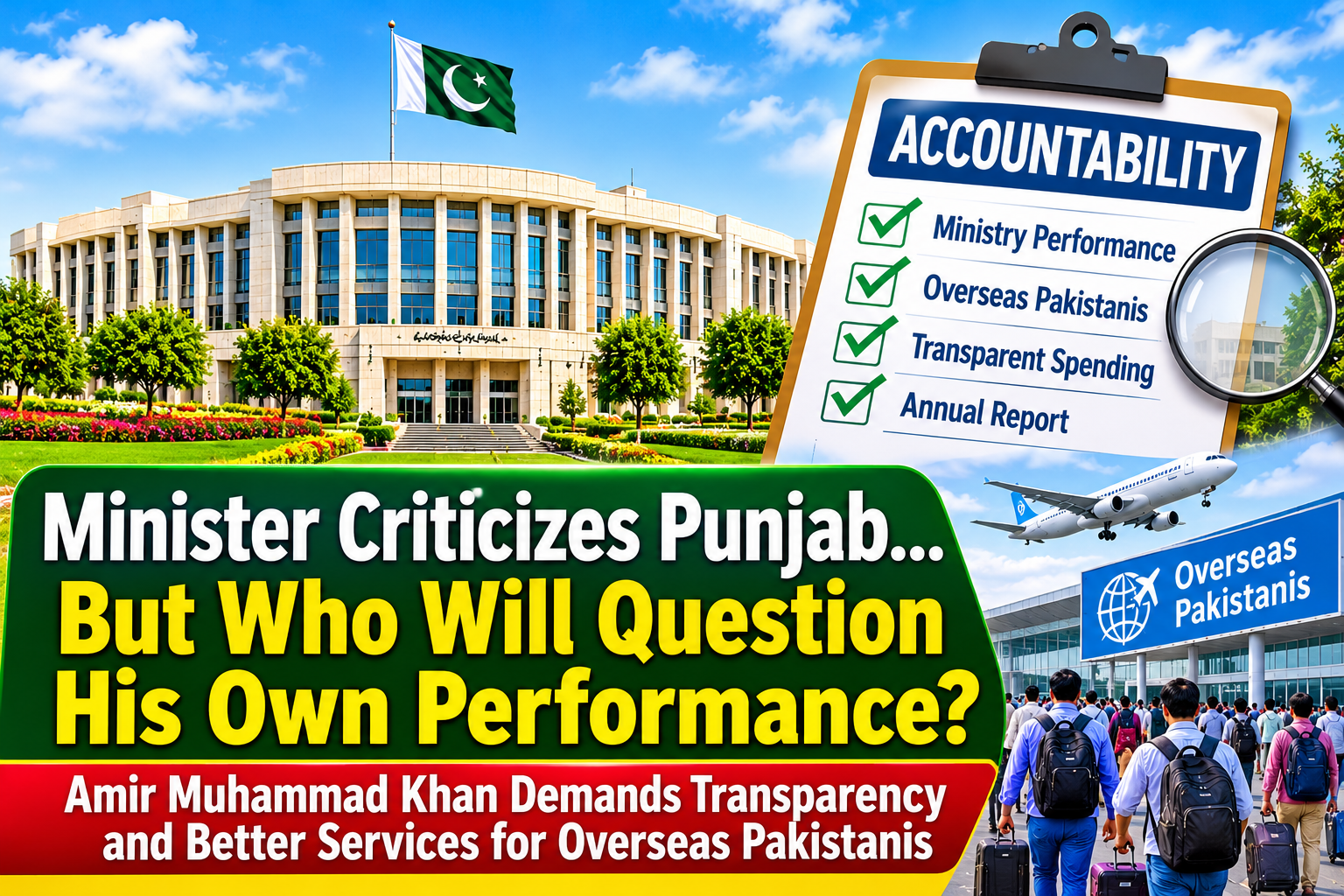
The Ministry of Overseas Pakistanis should publish an annual performance report containing:
-
Total budget allocated to the ministry.
-
Actual expenditure and details of major projects.
-
Number of complaints received from overseas Pakistanis.
-
Number of complaints resolved and pending.
-
Number of Pakistani workers successfully sent abroad through legal recruitment channels.
-
Performance of community welfare attachés and diplomatic missions.
-
Action taken against fraudulent overseas employment agents.
-
Initiatives introduced to protect workers and improve consular services.
Such reporting would allow Parliament, the media and ordinary citizens to evaluate government performance objectively.
Pakistan has more than ten million citizens living abroad who contribute significantly to the country’s economy and international reputation. Their welfare should remain a national priority, regardless of political differences.
Chaudhry Salik Hussain has every right to question the Punjab government’s spending, just as the Punjab government has the right to demand evidence and defend its financial decisions.
However, the same standards of transparency must apply to his own ministry.
True accountability is not about questioning others while avoiding scrutiny of one’s own department. It is about presenting facts, accepting responsibility and delivering measurable results for the people.